
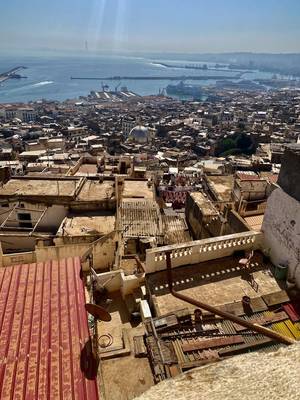
The “Casbah of Algiers,” a historic UNESCO World Heritage Site with its intricate labyrinth of streets and tunnels, played a critical role during Algeria’s struggle for independence from France, 1954 -1962.
Founded in the 10th century on old Roman ruins, it features a dense maze of traditional houses, Ottoman-era palaces, and mosques, acting as a key center of Algerian culture and national identity.
”Casbah” means the “old” city, an ancient fortress for protection from the many invading civilizations throughout the centuries trying to gain control of the Mediterranean Sea and its lucrative trade routes.
The site is heavily deteriorated, with many buildings at risk of collapse. However, it remains a bustling residential area, full of local life and traditional, hidden courtyards. It is said that 40,000 to 80,000 people live and work in the Casbah.
Posted April 10, 2026

The old Casbah of Algiers was built in the 10th century as a fortress from invading naval marauders. It was built on a hill overlooking the glorious Mediterranean Sea. It's estimated that currently ~40- 80 thousand people live and work there.

The contrast of this ancient fortress on the Mediterranean Sea was extraordinary.

The Casbah's winding/twisting streets and secret passages played a critical role during Algeria's struggle for independence from France in 1954-1962.


This ice cream station on the roof of the Casbah, wasn't open when we were there.


The narrow pathways of the Casbah punctuated by endless stairs. Thousands of people live and carry out their lives in the Casbah.

There were several more open areas in the Casbah with foliage.

We had to be very careful navigating the uneven walkways and many stairs.

This wood artisan in the Casbah makes intricately carved wooden privacy screens, used primarily in home windows to "protect" Muslim women from being seen by the public.

The wide variety of beautiful wooden goods in this artisan's inventory.

The beauty of this wooden hand carved screen was extraordinary.

Our lovely and knowledgable guide, Luna.

Hidden entrance to a series of underground labyrinths amongst houses and shops, used by the residents and Algerian soldiers during the Algerian War, 1954 - 1962. For details, watch the movie "The Battle of Algiers," made in the 1960s.

The heavy French influence on Algerian architecture and decor.


A shop where you could get dressed in traditional Algerian “costume” and be photographed.

One of 5 potable fresh water stations in the Casbah where residents can get water. There is no running water in homes. Women fill many buckets of water every day. The water comes from a well.

A young man rinses off after a futbol practice.
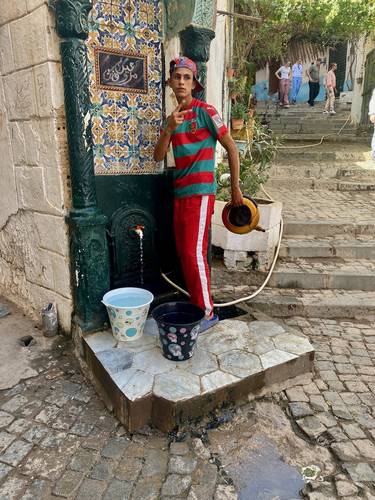
Water stations in the Algiers Casbah.

Many small shops and artisans along the way. No credit cards are accepted in North Africa - only cash.
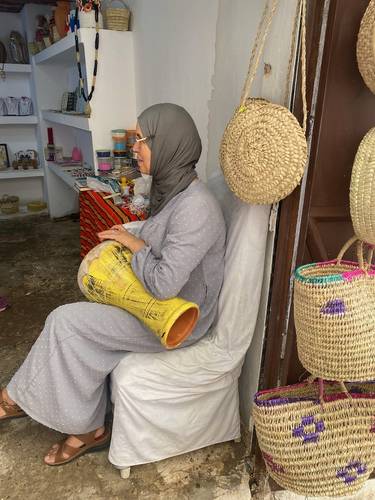
A Casbah merchant plays her drums for us.

Hot sweet mint tea and homemade pastries, after several hours of meandering.

An incredible assortment of deliciousness.

Algiers is a cat city. Feral cats are everywhere. They are probably important in controlling rats in this densely populated space.


A home's shower in the Casbah. No running water, so bathing is done with buckets of water.

A typical, tiny kitchen in a home in the Casbah.

A shoemaker in the Casbah in his generations old family business.


Lunch in a Casbah home.

The matriarch of the family, prepared our meal. Her kitchen is not reflective of the typical Casbah home. Her family caters to the tourists for an "in home" experience.

Enjoying our lunch of Algerian food in a more intimate setting. It was fun to meet the family members.

Many references throughout the Casbah of their beloved MCA futbol team.

The images of the seven martyrs of the Algerian War are displayed all throughout Algeria.

At the Rais Palace in Algiers. I love this photo of Luna in front of the blue Delft (from The Netherlands) tiles. Tunisian tiles are below, in traditional yellow and green colors. The wealth of a particular ruler was often measured by how many different tiles from different countries were on display in his palace/residence.

Typical Algerian tiles.


Conservative/traditional dress for some unmarried Muslim women in public.

Many examples of historic/traditional dress and artifacts at the Casbah's Museum of art.


Tourists who visit the Casbah, must be accompanied by an armed government “escort.” Here’s Luna with ours.

Canons poised to defend the city of Algiers.


We also visited Algiers' Roman Catholic basilica, "Notre-Dame d' Afrique (our Lady of Africa).

After 14 years of construction, the basilica opened in 1872, sporting neo-Byzantine architecture.


At the Basilica, we saw these two school girls on its steps. School children wear “aprons” as their uniform over their own clothes. Girls wear bright pink, and boys wear blue. (Naturally) Each student can personalize their tunic with special embroidery or action figures.